


Growing up in the Indian countryside during the 1980s, I heard many folk proverbs and village sayings. As I look back on my life now, I’m struck by how painfully accurate some of them were.
One proverb in particular has stayed with me:
“If you stand under a palm tree and drink milk, people will assume you are drinking palm wine.”

It captures what we now call guilty by association. The assumption may be unfair, but the world has never been patient with nuance.
Today, that proverb feels more relevant than ever.
Social media delivers instant verdicts before legal proceedings, facts, or proper investigation.
With unethical uses of AI, this has accelerated even further. I don’t need hours of editing or advanced Photoshop skills to damage your reputation. I can place your image under a palm tree, add a cup to your hand, and tell the world you are drinking palm wine—done in seconds.
You don’t have to commit a crime.
You only have to stay too long at the wrong table.
You don’t have to drink alcohol.
You only have to stand under the wrong tree with a cup in your hand.
More than ever before, we live in an age that demands discernment, and a deeper dependence on Scripture, not visibility, access, or association.
Bill Gates
I’ve never been particularly interested in what people say about Bill Gates. I’ve been more interested in what his work did to the world. For over three decades, I have admired the clarity of his early vision and the discipline with which he pursued it.
Long before personal computers became household objects, he articulated a simple but disruptive idea:
“A computer on every desk and in every home.”
At the time, it sounded unrealistic.
History proved otherwise.
Much of the modern digital world—laptops, tablets, smartphones, and the software ecosystems behind them—can be traced back to that vision.
I once wrote about this impact on LinkedIn while reflecting on the death of Paul Allen, Why Paul Allen’s Death Shook me, Gates’ early partner, and how the personal computer quietly reshaped human life.
My admiration is also personal. I still remember 1996, when I first used Windows 3.1 on a bulky black monitor paired with a Pentium machine. Sixteen megabytes of RAM and a two-gigabyte hard drive felt revolutionary. The system would occasionally drop to a command prompt, and restoring the graphical interface required patience and learning.
Those slower days taught us something modern technology often forgets: progress requires patience—and for Christians, patience is not just a skill. It is fruit of the Spirit.
Bill Gates & Epstein
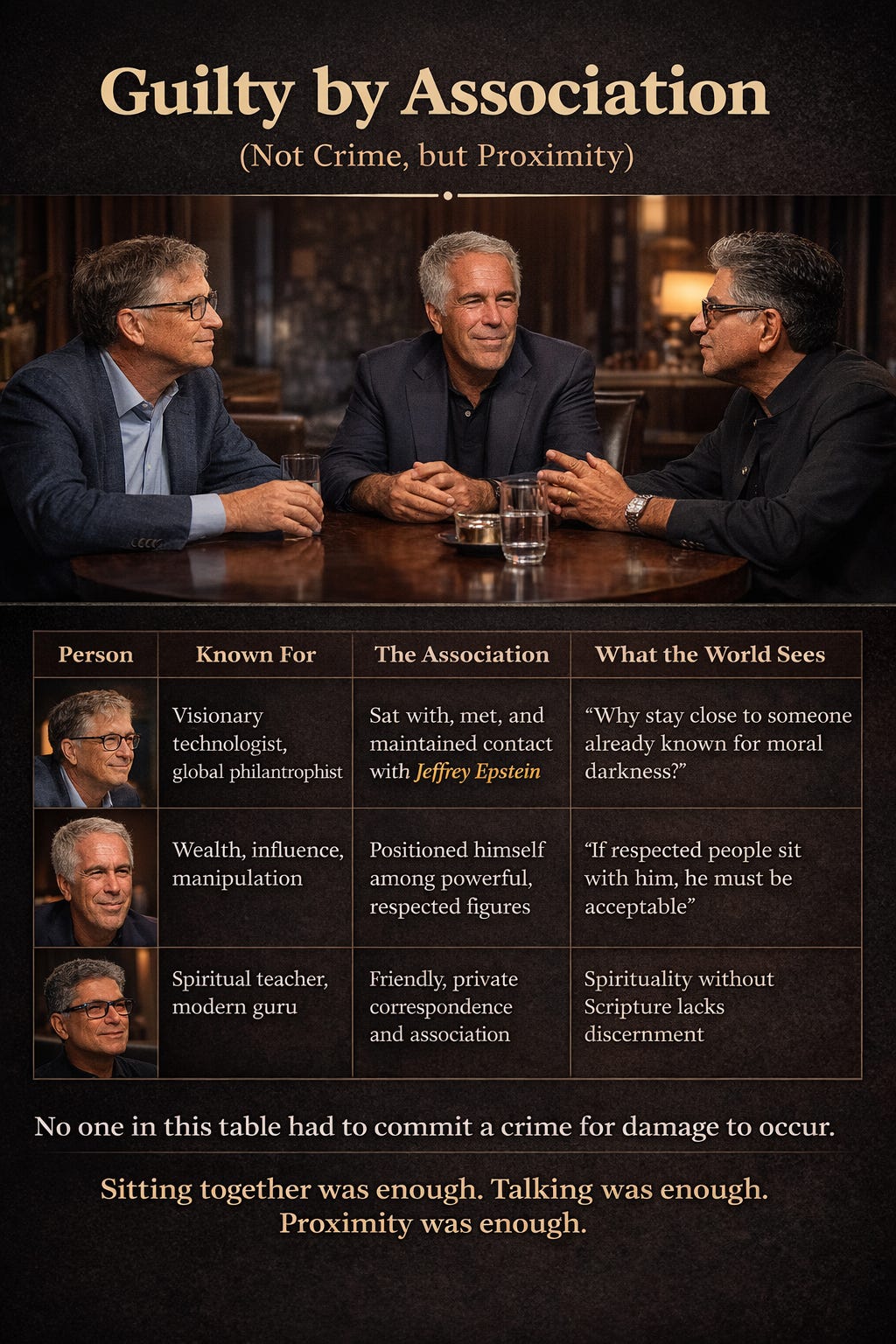
Over the past few years, Bill Gates has appeared in public reporting related to Jeffrey Epstein because of questions surrounding their association. On February 5, 2026, a detailed investigative report from CNN became the immediate catalyst for writing this reflection.
This is a wisdom reflection, not a legal accusation.
Let me be clear.
I am not writing a courtroom brief.
I am not assigning guilt.
Gates has consistently denied visiting Epstein’s island. Public reporting has also referenced unsent draft emails found in Epstein’s records—messages that were never delivered and do not constitute proof of action or agreement.
These distinctions matter.
I am neither an investigator nor a legal expert capable of analyzing millions of pages of documents. That responsibility belongs to prosecutors, journalists, and appointed authorities.
The question that concerns me is simpler—and more timeless:
How does a brilliant, disciplined, and highly accomplished man like Bill Gates allow sustained proximity to someone whose moral character was already under serious question?
That question has less to do with intelligence and more to do with anchors.
Knowledge alone does not protect a person from relational blind spots.
Success does not guarantee discernment.
And wisdom, when detached from Scripture, often trusts its own judgment longer than it should.
Knowledge Without Scripture
One of the quiet dangers of success is the belief that knowledge alone is enough. Intelligence sharpens the mind, but it does not protect the heart. Education increases ability, but it does not automatically produce discernment.
When knowledge operates without submission to Scripture, it slowly begins to trust itself as the final authority.
The Bible never speaks against knowledge. But it repeatedly warns against knowledge without reverence:
“The fear of the Lord is the beginning of wisdom” (Proverbs 9:10).
Scripture does not say wisdom begins with information, credentials, or experience. It begins with the fear of God—a posture that admits limits and welcomes correction.
When Scripture is absent, knowledge turns inward.
It listens to peers instead of prophets.
It seeks access instead of accountability.
It evaluates relationships by usefulness rather than character.
Over time, this creates a dangerous confidence: I am smart enough to manage this.
That confidence is often what keeps people in rooms they should have left much earlier.
The Apostle Paul offers a sober warning:
“Knowledge puffs up, but love builds up” (1 Corinthians 8:1).
Pride does not always announce itself loudly.
Sometimes it whispers, I know what I’m doing.
Scripture interrupts that whisper and asks harder questions:
Who are you walking with?
Who has permission to warn you?
What table are you sitting at—and why?
Are you standing under a palm tree with a cup of milk?
Scripture also protects us from overestimating our moral immunity:
“Do not sit with the deceitful, nor associate with hypocrites” (Psalms 26:4).
This is not about isolation.
It is about discerned proximity.
Knowledge can explain evil.
Scripture teaches us how to avoid its gravitational pull.
That is why Scripture is not merely informative; it is preventative.
It teaches us when to leave, whom to avoid, and how not to overestimate ourselves.
Spiritual but Not Religious
During my travels, I’ve met many people who proudly describe themselves as “spiritual but not religious.” You see them everywhere—especially in places like the Sacred Valley of Peru.
Ayahuasca ceremonies.
Mushroom trips sold as soul expansion.
Parrot prophecies.
Star-night yoga.
They claim spiritual awakening, but the mental, emotional, and spiritual costs are rarely discussed—and often devastating.
Scroll through social media and you’ll find the phrase everywhere: Spiritual, not religious.
I don’t argue with them.
I pray for them.
One of the most prominent figures often associated with this worldview is Deepak Chopra. Many of us—especially those from educated Indian circles—grew up hearing his name. His motivational spiritual quotes were translated into Tamil and published in local magazines. He was presented as enlightened, elevated, and harmless.
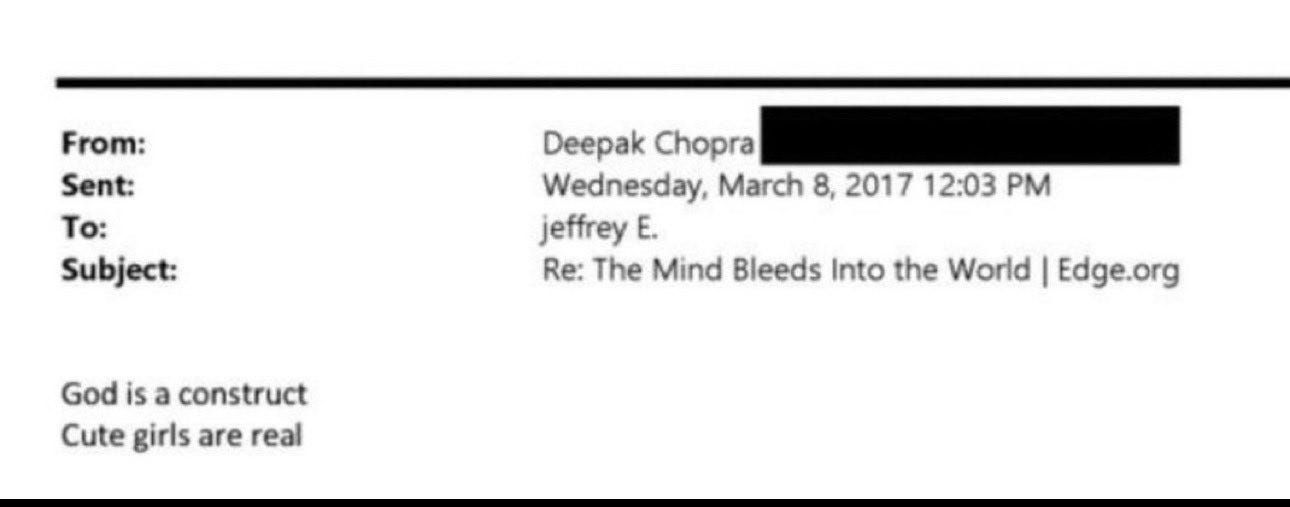
That is why it was jarring to see his name appear in correspondence connected to Epstein. Screenshots surfaced among many others—raising uncomfortable questions. Not legal conclusions. Spiritual ones.
How does a spiritual guru maintain intimate communication with a man whose moral darkness was already well known?
The answer is not complex.
Lack of God.
Lack of Scripture.
Pure pride.
Spiritual—but not religious.
Any spirituality detached from Scripture does not ascend; it decays.
When God is removed, discernment disappears.
When Scripture is rejected, boundaries collapse.
What remains is ego dressed up as enlightenment.
Spirituality without Scripture doesn’t protect you from evil.
It redefines evil until you can sit comfortably beside it.
The Spiritual Blind Spot
Success slowly weakens discernment. When people start winning, they stop listening. Power attracts predators—not loud criminals, but quiet manipulators who know how to flatter and wait. Over time, praise replaces correction.
People who speak hard truth are pushed away, while those who agree are kept close.
The real danger is not the trap itself, but the moment someone stops listening to warnings long before the trap appears.
Solomon: Wisdom Lost Through Proximity
Solomon was not a foolish man. He was one of the wisest people who ever lived. God Himself gave Solomon wisdom because he asked for it. Yet Scripture tells us something painful: his wisdom did not protect his heart.
“He loved many foreign women… and his wives turned his heart away” (1 Kings 11:3).
This did not happen overnight.
Solomon did not wake up one day and decide to abandon God.
His fall began slowly—through relationships he tolerated, alliances he justified, and voices he allowed to influence him.
Solomon did not lose knowledge.
He lost discernment.
He allowed proximity to pagans.
Temples to foreign gods were not built by rebels; they were built by a wise king who stayed too close for too long.
What you tolerate today becomes what you host tomorrow.
Solomon didn’t fall because he lacked wisdom.
He fell because he trusted it too much.
A Personal Warning to Christians
This is not theory for me.
It is lived experience.
There was a season in my life when I had proximity to pagans, immoral people, and those who openly thrived in sin. By God’s mercy, I never crossed legal lines. But do not mistake that for spiritual health. Proximity alone delayed my growth for years.
Emotional attachment without boundaries quietly poisoned my discernment.
In 2021, God interrupted my life.
Sanctification did not arrive politely; it arrived forcefully.
God began to separate me.
One by one, those relationships were cut off—not by drama, but by obedience.
Today, none of those people have access to my life.
No proximity.
No WhatsApp.
No social media.
God isolated me geographically in Latin America, not to punish me, but to protect me. Growth accelerated the moment separation was complete.
Christians, listen carefully.
Jesus is calling you—not tomorrow, today.
He is not trying to ruin your life.
He is trying to save your legacy.
You don’t need new revelations.
You don’t need spiritual shortcuts.
You need Scripture. Depend on it fully.
Scripture has already warned us—clearly and without apology:
“Blessed is the man who does not walk in the counsel of the wicked, nor stand in the way of sinners, nor sit in the seat of scoffers” (Psalm 1:1).
Notice the progression: walk, stand, sit.
That is how people fall—slowly, socially, quietly.
Evil rarely begins with participation.
It begins with proximity.
“Do not be deceived: Bad company corrupts good character” (1 Corinthians 15:33).

Read Psalm 1 often.
It will teach you when to walk away, where not to stand, and which tables you must never sit at.
This is not condemnation.
This is a rescue call.
God does not separate you because He hates people—
He separates you because He loves your calling.
Prayer
Heavenly Father,
Give me discernment before damage. Teach me to recognize danger before it feels familiar. Remove from my life every relationship, space, and influence that slowly pulls my heart away from You. I choose obedience over access, Scripture over opinion, and holiness over popularity.
Guard my heart.
Protect my calling.
Preserve my legacy.
Anchor me deeply in Your Word.
In Jesus’ name, Amen.
About the Author
Lawrence Manickam is a servant of the Lord and founder of Calvary International Mission. Born in India, shaped in Canada, and carrying Mexican permanent residency, he lives an international life, sharing the love of Christ across cultures. In July 2024, he completed his Master of Arts in Pastoral Counseling at Liberty University, Virginia.
He is the author of three Christian books:
📘 Free From Lo-Debar
A journey into restoration, identity, and the God who brings His children out of forgotten places.
📘 Hearing the Holy Spirit in Everyday Moments
A collection of true encounters, testimonies, and reflections on learning the voice of the Holy Spirit in daily life.
📘 Trump & Jesus (Pre-Order)
A bold and provocative exploration of leadership, faith, culture, and the spiritual forces shaping American history.
If you need biblical counseling, prayer support, or simply a listening ear, feel free to contact him.