

Compassion is Courage
When Love Walks Downward


The world says courage means climbing higher—winning, leading, conquering. But Jesus’ courage was different. His was a downward pull, not an upward chase. He stepped down from heaven to save us—leaving His throne to walk among us, serve us, and suffer with us.
True compassion always walks the downward path. Henri Nouwen calls this the “downward way of Jesus.”
To follow Him means letting go, standing last in line, and embracing the poverty of spirit. It means loving those who reject us, forgiving those who betray us, and walking with those who suffer—quietly, without applause.
The NYC Subway Door
I once stepped off a New York subway into a crowded platform. At the end stood a single revolving door—the only way in or out.
Anyone who’s been there knows how small and tight those doors are. People rushed out like a storm, pushing hard to escape. One wrong hand in the gap, and it could get crushed.
From a distance, I noticed a woman struggling to enter. It would’ve taken anyone just two seconds to slow down and let her in. I made up my mind—if she didn’t make it before I reached the door, I’d let her pass first.
When my turn came, I slowed, held the door, and said, “Go ahead.”
The man behind me tried to push, but stopped when I turned and looked.
Proved again—compassion is courage.
The woman’s eyes met mine—thankful, surprised, relieved.
Compassion is Credit
Years later, the same act of compassion returned to me—this time, at another NYC subway door.
I was struggling with a heavy suitcase from JFK Airport, trying to push it through the revolving door. People spun through without noticing.
Then a Delta flight attendant stepped forward and said, “Go ahead, I’ll push your bag through the next round.” She did.
That day, compassion met me again—quiet, unseen, yet strong.
Courage doesn’t always roar. Sometimes, it pauses for two seconds and holds the door.
We often think compassion is gentle and soft, but it requires courage.
It takes courage to stop when the world says run.
It takes courage to notice another person’s pain when everyone looks away.
It takes courage to go downward—to serve, to forgive, to love our enemies.
Peter wrote, “Wrap yourselves in humility to be servants of each other” (1 Peter 5:5).
And Jesus said, “Love your enemies and pray for those who persecute you” (Matthew 5:44).
That’s not easy.
It’s impossible without the Spirit of Christ within us.
Café in Tacna
I’m writing this blog from Tacna, Peru—a clean, peaceful border town near Chile. From here, the Chilean immigration post is only twenty-four kilometers away. Because of the stronger Chilean peso, many Chilean visitors cross the border daily for shopping, medical care, and pharmacies. It’s similar to Tijuana in Mexico, but far safer and quieter.
I often come to a coffee shop called Tunkimayo, a local chain known for its delicious pastries and coffee. The name “Tunkimayo” also belongs to a village and region in the Puno and Cusco areas of Peru, where Aymara families grow coffee.
As I write this, I see a beautiful family with three children seated at a booth. Because of limited space, they added an extra, shorter chair. The youngest, barely three feet tall, sat on it, unable to reach the table. He balanced his plate on his lap while his older siblings kept eating, and the parents didn’t seem to notice.
It would have taken just one small act of compassion—one of the older children standing up for their brother. Yet sometimes, even in loving families, compassion gets forgotten.
It takes courage to notice and to act, even when the world calls it small.
The Spiral
While reading Compassion: A Reflection on the Christian Life by Henri Nouwen, I was struck by his idea of the downward path of Jesus Christ. Reading good books always gives birth to inspiration. It opens the wings of imagination, and when combined with the spiritual gifts of wisdom and knowledge, the result becomes even more meaningful.
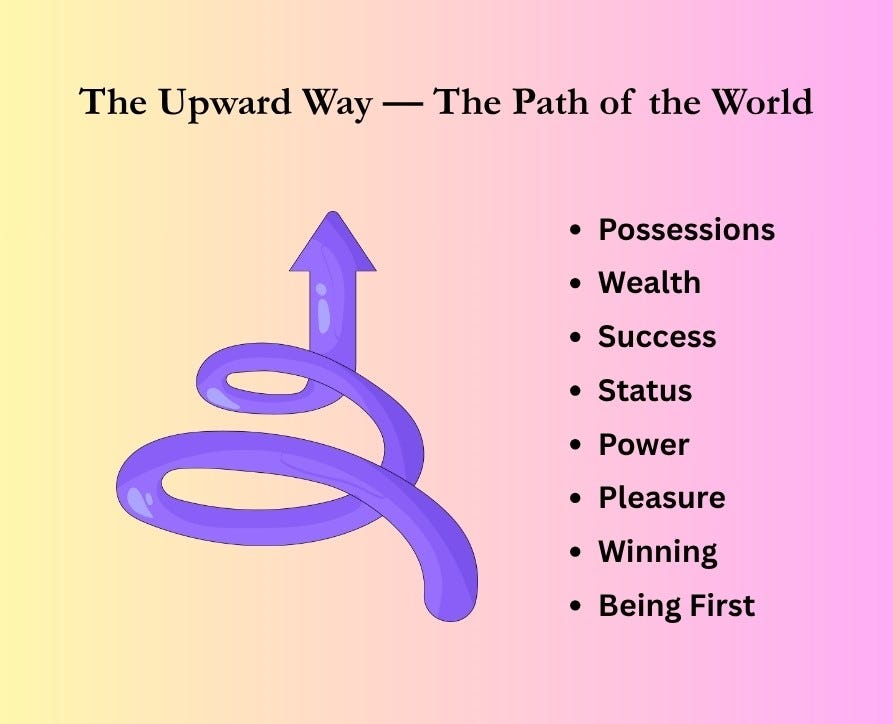
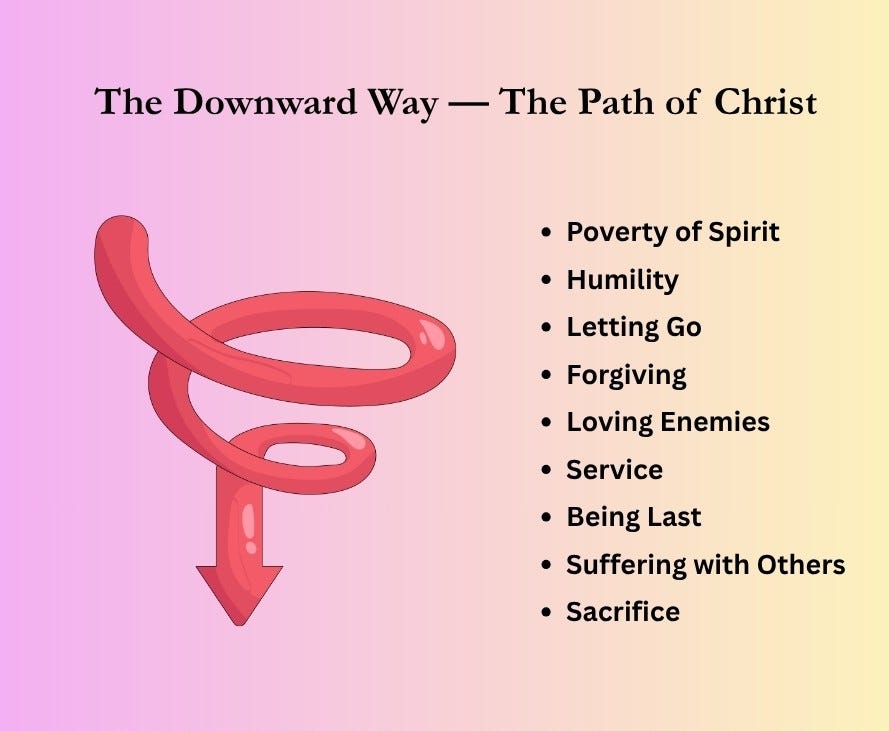
I took some time to draw these spiral diagrams in Canva.
The world teaches us the Upward Spiral —
Possessions. Wealth. Success. Status. Power. Pleasure. Winning. Being first.
The world climbs upward to pride and power.
Jesus invites us to the Downward Spiral —
Poverty of Spirit. Humility. Letting Go. Forgiving. Loving Enemies. Serving. Being Last. Suffering with Others. Sacrifice.
Christ descends downward to humility and love.
No one naturally likes the downward spiral.
Who wants to go downward?
We like the downward path when it leads to pizza at our front door—but not when it leads to a cross.
Yet Philippians 2:9–11 reminds us: “God raised Him up and gave Him the name above every name.”
The upward glory comes only after the downward obedience.
This glory may not bring us wealth or fame in this world, but it promises a glorified body and eternal life with Him.
It just takes time.
Courage to Go Downward
We often want to be saved or inspired by people who appear superior to us.
Our doctor must be healthy; otherwise, we question his right to teach us about wellness.
Our pastor must live a spotless life; otherwise, we doubt his moral authority.
Do you remember the movie True Lies (1994) with Arnold Schwarzenegger? In that iconic scene, Arnold’s character, Harry Tasker, rescues Jamie Lee Curtis from a speeding limo by dangling from a helicopter and grabbing her as the car falls from the Seven Mile Bridge.
I remember watching it with a friend who said, “Lawrence, that’s believable.”
Of course—with Schwarzenegger’s strength, we believe it. He looks capable of lifting anyone with one arm.
But Jesus was different. He was meek—an average-height, ordinary-looking man.
He came not to impress, but to serve.
He came to rescue us not from a helicopter, but from the weight of sin.
He struggled under His cross and fell many times.
He wasn’t a superhero.
Yet He had a courageous heart—the courage to obey the Father’s will.
He could have escaped to Africa or Europe, but He chose to walk toward Calvary, carrying His own cross.
That was compassion in its highest form, courage in its deepest sense—love that bleeds, courage that kneels, strength that serves.
The Courage of Dr. Joel Filártiga
While reading Nouwen’s Compassion, I noticed he dedicated the book to Dr. Joel Filártiga and filled it with his haunting drawings. Each sketch carried both pain and prayer.
Dr. Joel Filártiga was a Paraguayan physician—a man of compassion who spent his life healing the poor and speaking against injustice. In 1959, he opened a small clinic for farmers and indigenous families in Ybycuí, Paraguay. He was also a gifted painter whose art spoke the language of mercy and protest. Deeply influenced by Christian ethics, his words often echoed the Gospel—forgiveness, justice, and human dignity.
In 1976, tragedy struck when his teenage son, Joelito, was tortured and murdered by agents of the dictatorship. For any parent, such grief could end all faith in humanity.
But Filártiga answered with a higher kind of courage—not revenge, but justice.
With his daughter Dafne, he carried his pain into the courts, filing a historic case in the United States against the man responsible. The ruling—Filártiga v. Peña-Irala (1980)—became a cornerstone of modern human-rights law, declaring that torture anywhere is a crime against humanity everywhere.
“This is not vengeance,” he said. “This is the cry of my son for justice.”
Even under threat, he continued treating the poor. His courage was not loud or political—it was the quiet courage of compassion, the strength to seek justice without hate.
When he died in 2019, tributes poured in from around the world. Yet his true memorial lives on in every voice that still dares to say, “Justice belongs even to the smallest.”
The world’s spiral climbs upward to pride and power.
Christ’s spiral descends to humility and love.
Only one of them leads to peace.
“Be merciful, even as your Father is merciful” (Luke 6:36)
Conclusion
Compassion is not weakness. It is the courage to go downward when everything in us wants to rise. It is choosing presence over power, mercy over judgment, and humility over recognition. Whether in a crowded subway or a silent courtroom, compassion always costs something.
But when we walk that downward spiral with Christ, we discover the truth Nouwen saw so clearly: the way down is the way to God.
Prayer
Lord, give me courage to walk the downward path. Teach me to see those who struggle, to slow down, to serve. When I fear losing my place, remind me that You stood last for me. Let compassion become my courage. In Jesus’ name, Amen.
About the author
Lawrence Manickam is a servant of the Lord and founder of Calvary International Mission. He is a Canadian Indian with Mexican permanent residency, living an international life and sharing the love of Christ across cultures. In July 2024, he completed his Master of Arts in Pastoral Counseling at Liberty University, Virginia.
Feel free to contact him if you need biblical counseling, prayer support, or simply a listening ear.
✨ Want more encouraging messages like this? Subscribe to his Substack to receive future posts straight to your inbox.