

Between His Yes and When
What to do when God has spoken and nothing has happened yet

I ignore most of my dreams.
I should say that at the beginning, because I am about to build an entire blog around one.
In this season of my life, most of what comes to me at night I simply let go. Some dreams are noise. Some come from the fears and pressures we carry through the day. And I also believe there is a spiritual battle around the work of God—when people gather to hear and discuss the Word, the enemy is not pleased. So, I usually wake up, pray, and move on.
But this one stayed with me.
Before I tell you about it, let me tell you why I do not dismiss dreams completely.
The year was 1992. My father had been gone for two years by then; he died in 1990, when I was fourteen. I was waiting for an engineering admission that did not seem to be coming. Almost everyone I knew had already joined college. I remained on a waiting list for months, with no influential person to make a phone call on my behalf and nothing I could do to move myself forward.
Then one night I saw my father in a dream.
He spoke the name of a college.
I had never heard of that college. Two weeks later an admission letter arrived, and the name printed on it was the name I had heard in the dream. There are people still living today who know this happened.
I am not building a doctrine around my dream. Scripture is sufficient, and our dreams must never become our theology. But God can use any voice He chooses, and He chose the one voice a fatherless boy would have obeyed without question.
Scripture itself shows us that God has used dreams at different moments in redemptive history. Joseph dreamed. Daniel interpreted dreams. Joseph, the earthly father of Jesus, received direction repeatedly in dreams. Joel spoke of dreams in connection with the outpouring of the Spirit.
I do not chase dreams. But neither do I dismiss every one of them.
Two days ago, I had one I could not easily forget.
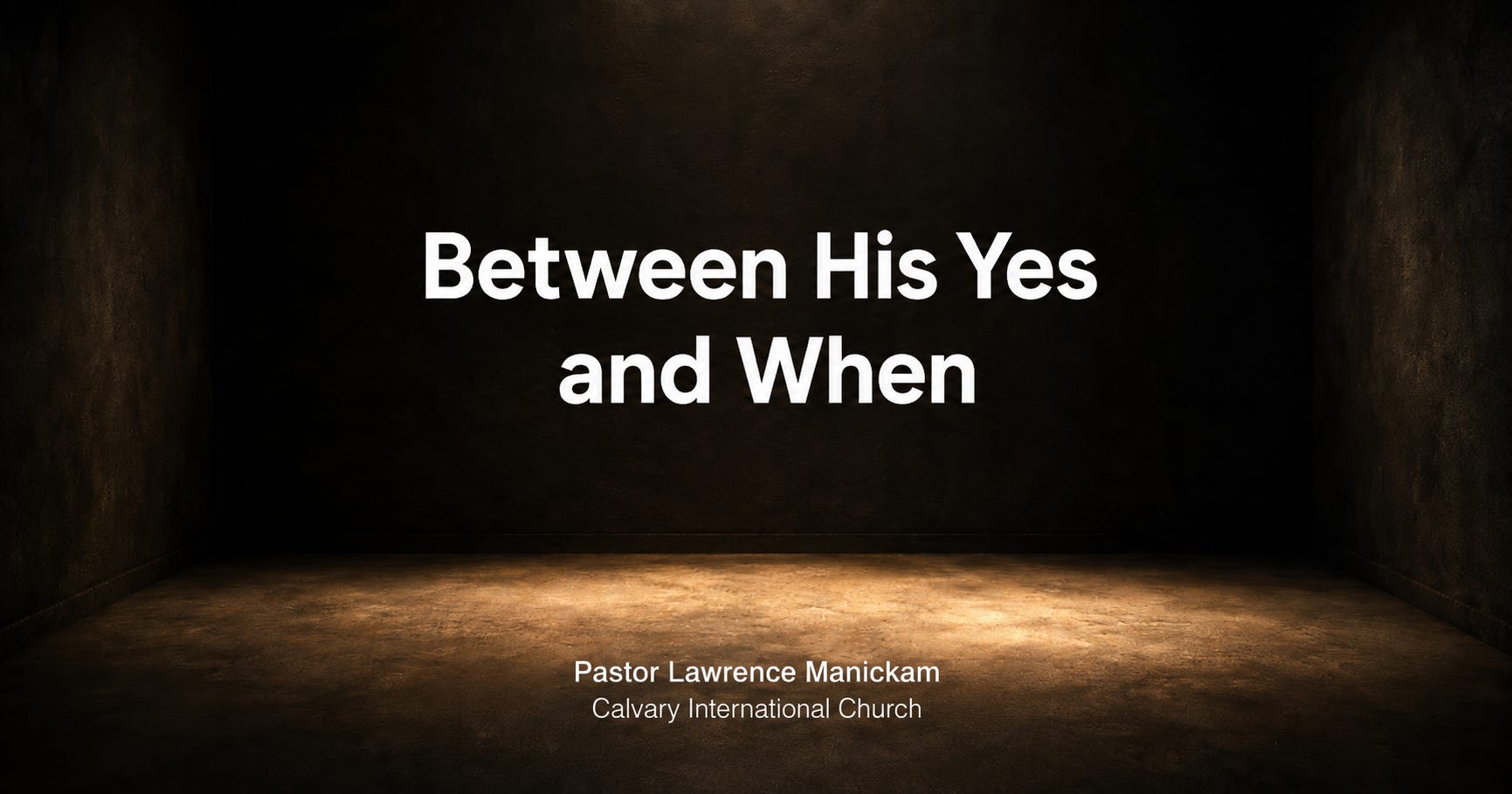
The central picture was simple. I was kneeling inside a closed room. The walls were black, but there was good light inside the room. And I was crying out to God:
How long, Lord? How long?
Then I woke up.
There was no answer.
And as I write this, the answer still has not come.
I understand why those words came out of me.
I am tired.
There is the ministry. There is an AI training center I am trying to build. There is PhD work and another season of applications ahead of me. There is an IT market that has changed dramatically. There are financial uncertainties. There is a property matter in Canada I have carried for years without resolution.
And there is Mexico. I love this country. God has given me wonderful friendships here. But every immigrant knows there are moments when a country gently reminds you that you are still a foreigner. I am learning Spanish every day. I am trying to build a ministry in a language that is not mine.
We still do not have a place for the church.
And I will admit something else. Sometimes I am afraid to commit to a place because of the money. At other times I am afraid I will commit to the place, open the doors—and nobody will come.
Those things can create a black hole inside the mind. And somewhere from the bottom of that hole came a very old biblical prayer:
How long, Lord?
Paul writes that there are moments when we do not even know what to say, and the Spirit helps us in our weakness with groanings too deep for words. Perhaps sometimes prayer begins before we have found the sentence.
Mine had found two words.
So I went back to Scripture, and I discovered that I was standing in very crowded company.
The distance between God’s promise and its fulfillment can sometimes be measured not in days or months, but in generations. There is a place between His Yes and His When. And that place can hurt.
The Promise Came First. The Waiting Came Anyway.
God made Abraham a promise. But He also told Abraham that the promise would travel through a long and painful history.
“Know for certain that your offspring will be sojourners in a land that is not theirs and will be servants there, and they will be afflicted for four hundred years.” — Genesis 15:13
Four hundred years.
Not four hundred days.
Not one difficult season.
Generations.
There were Israelites born as slaves who died as slaves. There were mothers who told their children about the God of Abraham, Isaac, and Jacob, yet never personally saw Moses stand before Pharaoh. Imagine carrying a promise that your grandmother carried before you.
The promise was true.
But it was not yet.
Then Exodus tells us that Israel groaned under slavery. God heard them. God remembered His covenant. God saw the people of Israel. God knew.
Those words matter. When Scripture says God “remembered,” it does not mean the covenant had slipped His mind and suddenly returned to Him. It means the moment had arrived for God to act upon what He had already promised.
God can be silent without being absent. And God can appear inactive while His promise remains completely alive.
I know the familiar Christian phrase: delay is not denial. It is true. But sometimes we say it too easily. Try telling someone who has prayed for ten years that delay is simple. It is not. Waiting hurts even when the promise is real.
Eleven Days that became Forty Years
Eventually Israel came out of Egypt. Pharaoh was behind them. The sea had opened. The army that pursued them had been destroyed. And the Promised Land was ahead.
Then Moses gives us a small geographical detail:
“It is eleven days’ journey from Horeb by the way of Mount Seir to Kadesh-barnea.” — Deuteronomy 1:2
Eleven days.
Yet that generation wandered for forty years.
Here we have to make an important distinction. The four hundred years and the forty years were not the same kind of waiting. The centuries in Egypt were part of a timetable God had already revealed to Abraham. The forty years in the wilderness came after unbelief and rebellion.
Ten spies looked at the giants. Joshua and Caleb looked at God. And Israel chose the report of fear.
So sometimes, while asking God “Why am I waiting?”, there is another prayer worth asking:
“Lord, is this Your timing, or am I walking around the same mountain?”
That is not a question of condemnation.
It is a question of surrender.
Sometimes God tells us to wait. Sometimes God tells us to move. Sometimes fear calls itself wisdom. Sometimes impatience calls itself faith. We need the Holy Spirit to know the difference.
But if you have searched your heart honestly, obeyed what God has shown you, and the door still has not opened, do not punish yourself for God’s timetable. You do not control the calendar.
David Asked It Four Times
Psalm 13 begins without religious cosmetics.
“How long, O LORD? Will you forget me forever? How long will you hide your face from me?” — Psalm 13:1
David keeps saying it.
How long?
How long?
How long?
How long?
I love the fact that God allowed this prayer into Scripture. The Holy Spirit did not edit David’s frustration out of the Bible. God allowed His people to sing it.
There is something important here. Lament is not necessarily the absence of faith. Sometimes lament is what faith sounds like when it has been waiting for a very long time.
Think about it. David is still talking to God. You do not keep asking someone a question if you believe that person is not listening.
But Psalm 13 does something beautiful. The situation does not visibly change between the beginning and the end of the psalm. David changes. He begins with How long? and ends with I have trusted in your steadfast love.
He does not receive a date.
He remembers a Person.
Sometimes faith is praising God before the calendar changes.
Habakkuk Asked Too
Habakkuk opens his book with the same cry:
“O LORD, how long shall I cry for help, and you will not hear?” — Habakkuk 1:2
This is not the complaint of someone who has never prayed. Habakkuk has been praying.
Sometimes we quietly assume that if a prayer remains unanswered, the person must not have enough faith. Maybe they did not pray correctly. Maybe they are not spiritual enough. Maybe there is some hidden formula they missed.
Habakkuk destroys that simplistic theology. A faithful person can pray faithfully and still ask: How long?
And when God answers Habakkuk, He says something extraordinary:
“For still the vision awaits its appointed time... If it seems slow, wait for it; it will surely come.” — Habakkuk 2:3
There is an appointed time. Habakkuk is not given control over it. And neither are we.
But notice something else in the book. While Habakkuk is asking God why He is not doing something, God is already at work. Habakkuk simply cannot see it yet.
That may be one of the hardest truths of waiting: God may already be doing something while I am asking Him when He is going to start.
Isaiah Asked It After He Said Yes
This one stays with me.
Isaiah sees the Lord high and lifted up. The temple fills with smoke. His lips are cleansed. Then comes one of the most famous calls in Scripture: “Whom shall I send, and who will go for us?”
Isaiah answers: “Here am I! Send me.”
We love that verse.
We preach from it.
We put it on missionary banners.
We stop reading.
But Isaiah’s story keeps moving. Only a few verses later he asks:
“How long, O Lord?” — Isaiah 6:11
Notice the order. “Send me” came before “How long?”
And notice the answer he receives. God does not comfort him. He tells Isaiah it will last until the cities lie waste without inhabitant. Sometimes God answers our question with something harder than silence, and He is still good.
We sometimes imagine the Christian journey like this: calling, obedience, breakthrough. But Isaiah shows us another possibility: calling, obedience, difficulty, waiting, How long?
The same prophet said both sentences. “Here am I. Send me.” And: “How long, O Lord?” There was no contradiction.
You can obey God and still become tired. You can know your calling and still wonder about the timing. You can say yes to God without understanding what His yes is going to cost you.
Perhaps “Here am I, send me” is not the end of the faith story. Sometimes it is the beginning of “How long, Lord?”
Even Heaven Asks the Question
Then we arrive at Revelation 6. Under the altar are the souls of those who were killed because of their witness. They are with God. Their earthly suffering is over. And yet they ask:
“O Sovereign Lord, holy and true, how long...?” — Revelation 6:10
That amazes me. Even there, the story has not yet reached its final page. And their question is not rebuked.
They are given white robes. And they are told to rest a little longer.
Notice again what they do not receive. A date. They receive enough for the next stage: a robe, a promise, and a command to rest.
Maybe that is often how God deals with us. We ask Him for the entire calendar. He gives us enough grace for tomorrow.
What Do We Do Between His Yes and His When?
I am asking this for myself as much as for anyone reading.
First, keep showing up. Do whatever faithful thing is available to you today. If six people gather around a café table to open the Bible, teach those six. If one application can be completed today, complete it. If all you can do is pray, pray. Do not despise small beginnings because you expected something bigger.
Second, tell God the truth. Do not turn your pain into religious vocabulary because you think God cannot handle the real sentence. David said, “How long?” Habakkuk said, “How long?” Isaiah said, “How long?” The martyrs said, “How long?” You can say it too.
Third, receive ordinary provision without despising it. We sometimes become so focused on the large answer that we fail to recognize the daily bread. God provided for Elijah through ravens. Paul made tents. The spectacular work of God does not make ordinary provision unspiritual. If God opens a smaller door while you are waiting for the large one, do not immediately reject it because it does not look like the promise. It may be manna for this part of the journey.
And finally, refuse the lie that silence means absence. Those are not the same thing.
The Fullness of Time
There is one more biblical picture I cannot leave out.
For centuries Israel waited for Messiah. Prophets spoke. Generations died. Empires rose and fell. And then Galatians says:
“When the fullness of time had come, God sent forth his Son.” — Galatians 4:4
I love those words. The fullness of time. Not when Israel controlled the schedule. Not when somebody finally forced heaven’s hand. When the fullness of time had come, Jesus came.
And we Christians are living inside another wait. Christ has promised to return. We have His promise. But Jesus did not give us the date.
So, in a very real sense, the entire Church is living between His Yes and His When.
The martyrs ask: How long? The Church prays: Come, Lord Jesus. And Jesus says: Surely, I am coming.
We have His Yes.
We do not have His When.
Maybe that is why Scripture gives us permission to ask the question without shame.
The Light Was Already On
I do not know what you are waiting for tonight.
Maybe it is healing.
A job.
A child.
A relationship restored.
A ministry door.
Financial provision.
An admission letter.
A prayer you have stopped mentioning to other people because you are tired of explaining why it still has not happened.
I cannot give you the date. And I will not insult your pain by telling you that waiting is easy.
But I can tell you what Scripture tells me. God has heard people ask “How long?” for thousands of years. He did not abandon Abraham’s descendants. He did not abandon David. He did not abandon Habakkuk. He did not abandon Isaiah. He has not forgotten the martyrs. And He has not changed.
So perhaps faith does not always mean that I stop asking How long, Lord? Perhaps faith means I ask it while still holding on to Him.
I do not know when. I may not understand how. Sometimes I certainly do not understand why.
But I know Who.
I have thought about that room many times since the dream. The walls were black. But the light was already on. I did not have to wait for the light in order to kneel. I was kneeling in a room that was already lit, and I simply had not looked up.
Perhaps that is the truest thing I can tell you tonight. The waiting is real. The walls are dark. But the light in the room was never switched off, and the One who lit it has not left.
So, tomorrow morning, until the answer comes, I will get up and do the next faithful thing. Because between His Yes and His When there is still a life to live. There is still a calling to obey. There are still people to love. There is still work to do.
And there is still a God who is present in the room while we wait.
Pastor Lawrence Manickam
Calvary International Church
About the Author
Lawrence Manickam is the founding pastor of Calvary International Church, Mexico City. Born in India, shaped in Canada, and called to Mexico, he shares the love of Jesus across cultures through writing, teaching, and personal ministry.
He holds an MA in Pastoral Counseling from Liberty University and is the author of three books, including Trump & Jesus—Find them all here Amazon author page link.
Need prayer, biblical counseling, or a listening ear? Reach out anytime. And if this message encouraged you, subscribe to receive future posts in your inbox.